Bird spotting: Looking for Flamingos in Mumbai
- Jan 17
- 4 min read
Updated: Feb 26
Flamingos are one of the most distinctly identifiable, wading birds of the world. One morning I went looking for the bird species marked with pink feathers, slender legs and curvy necks. Here's what I found.
Reading time: 4 minutes | Published link

Mumbai’s bird expert, Neeraj Chawla is gearing up to camouflage in nature. The nip in the air is ripe for his adventure to go Flamingo spotting in the city’s swampy lands. In his opinion, one must merge with the surrounding landscape to catch Flamingos in their true element.
But where do they come from? He tells me,
“Flamingos migrate from their breeding site at Gujarat to Mumbai via the west coast. They reach the shorelines in November and turn into the city’s residents till May. For bird watchers, December and January is a peak time to spot the marvel of these winter friends."
Neeraj is a bird specialist who has captured more than 55 species across a span of twelve years at Charkop, Kandivali.
Booting up for Flamingo spotting
Almost twenty years after his first visit to Sewri, Neeraj has a checklist ready before he embarks on a journey to catch their glimpse. He lays down a blueprint to be ensured before one emabrks on the journey:
1. As a bird watcher one must carry a good pair of binoculars (7x40) (Magnification factor 7x to 10x range or higher) to spot and study the behaviour of the bird.
2. In case you are a beginner, hire a field guide to the area you are visiting to identify Flamingos.
3. Carry a notepad and a pencil to note down important observations for record-keeping and research.
4. A bird-watching hat is a must in the outdoor sun and the dress code should be light colours in brown, grey or green shades to camouflage with nature. It is advisable to avoid wearing bright colours like white and red to avoid distracting them.
5. Warm clothing is also important as it is an outdoor activity and takes hours of waiting to observe the orchestrated dance of Flamingos. A jacket with big pockets comes in handy to carry useful paraphernalia.
6. Pack a backpack with water bottles and other personal belongings to stay hands-free.
7. A keen twitcher (a serious bird watcher) also carries a spotting scope and audio recording equipment to spot and record the peculiar sounds of the bird.
8. Grab your hands on a good DSLR with a telephoto lens (Minimum 300mm focal length) to capture their stunning appearances.
Iconic places to spot the pink beauties
Thane Creek Flamingo Sanctuary

Mumbai is a temporary home to Flamingos. They take residence in the city’s swamps from November till June.
Each year, thousands of Flamingos arrive at the Flamingo Sanctuary from Rann of Kutch, Gujarat. During low tides, the vast marshy land gets covered with fresh algae which serve as a meal for the winged visitors. Notably, it is the consumption of algae which imparts the pink color to their body. Thane Creek is a designated spot to watch Flamingos and is accessible via road. Upon arriving here, birdwatchers can embark on a boat safari which starts at the Coastal Marine Biodiversity Centre in Airoli and runs up to a stretch of 10 km offering a wide vantage point to observe the flock.
Sewri Mangrove Park
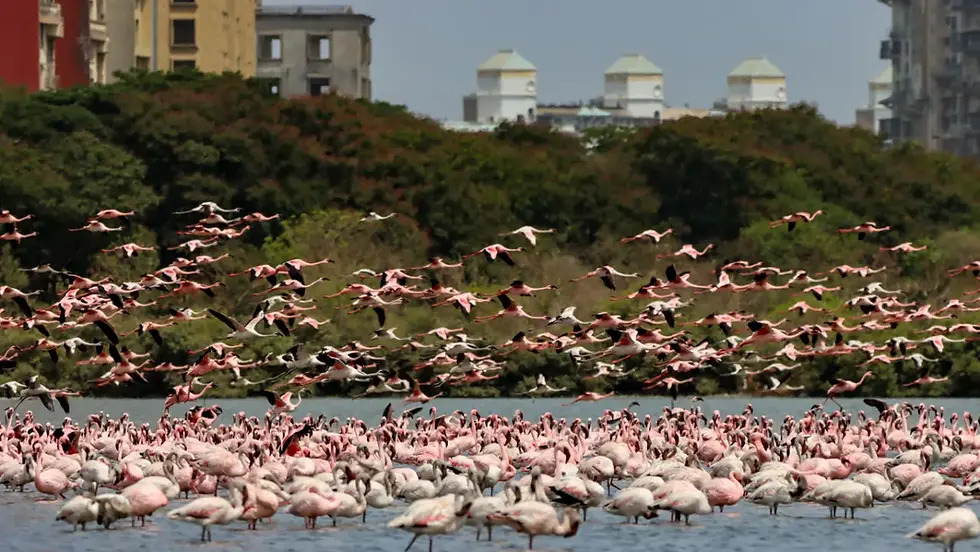
The peak season ranges between February to May during which 100-150 thousand birds are estimated to be in and around Mumbai.
Flamingos were spotted at Sewri mudflats in early 1990 for the first time. Bombay Natural History Society performed an extensive study on the subject and began conducting regular tours for wildlife enthusiasts. Now, BNHS runs Flamingo sighting tours which begin at the railway crossing at Sewri. Neeraj recommends carrying a pair of binoculars to get a closer look and study the behaviour of the birds. For photographers, a telephoto lens (400 mm and higher) works wonders to capture their poised movements.
Tawale Wetlands, Nerul, New Mumbai

Mumbai receives 2 out of 6 species of Flamingos, the Greater and the Lesser Flamingos in huge numbers because of a favourable winter weather, habitat, and food.
Flamingos paint the wetlands pink with their harmonized postures that seem no less than a choreographed move. To witness this wonder, birdwatchers can arrive at the Tawale Wetlands via road as well as barefoot. It is important to note that the right time to spot them in the lake is either early mornings or evenings. These timings are also apt to capture photographs as per the lighting conditions.
Bhandup Pumping Station

Some of the postures that can be witnessed in and around Mumbai are courtship dance, head-flag and wing salutes.
Wildnest curates wildlife safari and bird-watching tours in and around Mumbai. One of their offerings is a Flamingo sighting tour in boats that offer close-up vistas of the winged birds. Upon reaching here, visitors are greeted by the Wildnest team members at the meeting point. Next up, they proceed to Bhandup Pumping Station where they receive a brief introduction about flamingos as well as other birds that can be spotted. Later, they embark on the boat ride where the team helps in spotting flamingos as well as other shore birds found there with binoculars.
Flamingo species and their ritual dance
Out of a total of six species of Flamingos in the world, only two species have been identified in India. Two species that visit Mumbai from Gujarat state are:
- Lesser Flamingo ( Phoenicopterus minor): Small in height (80-105 cm), shorter neck, bill smaller and black-tipped dark red colour.
- Greater Flamingo (Phoenicopterus ruber): Tall in height (125-145 cm), with a longer and thinner neck, bill larger and pink in colour with dark tip.
Neeraj observes that both species exist in harmony.
A social breed, Flamingos can be spotted synchronizing a ritual dance in the swamps of Mumbai. With a knack for theatrics, they display collective postures and orchestrated whirls that are a delight to nature and wildlife enthusiasts. Some of the postures that can be witnessed in and around Mumbai are “Head-Flag”, “Wing-Salute”, and “Twist Preen”.


Comments